
Direct Marketing of Renewable Energy — Why It's More Complex Than It Looks
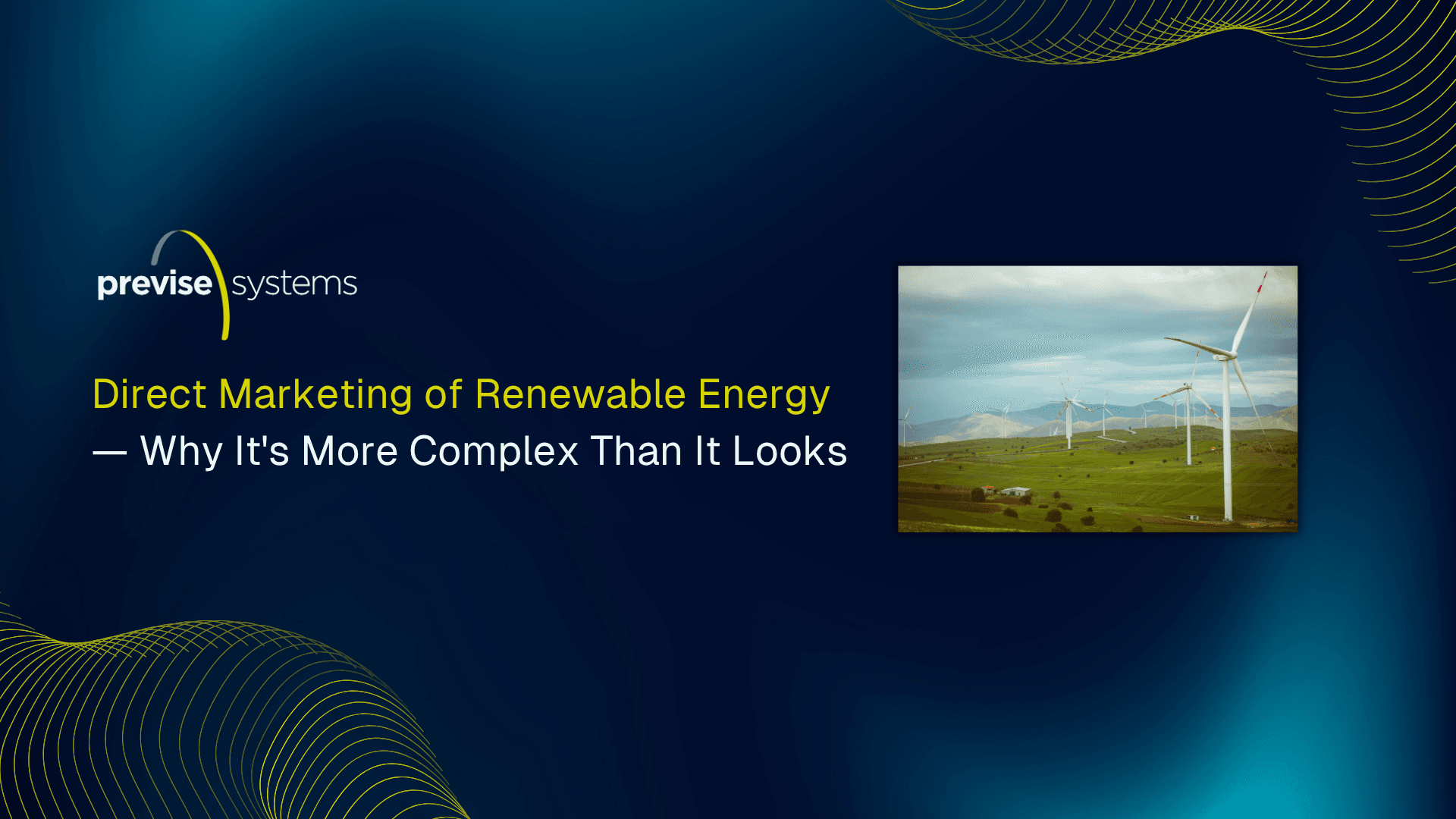
Renewable energy has become a core part of the European grid. And with that growth comes a more complex commercial reality for producers, aggregators, and direct marketers. As European energy markets have matured, the way renewable electricity is sold has fundamentally changed — and for many operators, navigating that change brings a level of operational complexity that is easy to underestimate.
What is Direct Marketing?
Direct marketing (Direktvermarktung) of renewable energy has been a legal requirement for most solar and wind operators for a number of years. Rather than receiving a fixed government feed-in tariff, operators sell their electricity across spot markets and complex term structures — receiving a market premium on top to cover the difference between the market price and a guaranteed reference value (anzulegender Wert).
Direct marketing is most advanced across Europe, specifically in Germany, France, Austria, Italy, the Netherlands, and Switzerland, where it is primarily driven by legal mandates requiring operators to market electricity above certain capacities. In Germany, the market premium model was introduced in 2012 to integrate renewables into the market, and by 2014 direct marketing had become mandatory for most new, larger photovoltaic and wind systems — typically above 100 kW. In Switzerland, direct marketing became mandatory for certain systems from 1 January 2020.
Since 2017, the reference value used to calculate the market premium is determined through competitive auctions for most larger systems, replacing the fixed state-set tariffs of earlier years. The result is a market-driven model where producers and their direct marketers must actively manage pricing, forecasting, and settlement — rather than simply receiving a guaranteed payment.
Why is it complex?
Direct marketing involves managing multiple layers of complexity simultaneously.
Pricing — beyond the market premium, direct marketers must account for flexible day-ahead and intraday pricing, where electricity prices fluctuate hourly based on supply and demand, as well as complex term structures that add further layers to contract management.
Fees — direct marketers charge service fees, typically between €1–€5 per MWh, which can include balancing costs. These fees are layered and contract-specific, making them one of the more demanding aspects of direct marketing agreements to manage accurately.
Redispatch and curtailment — grid operators can instruct producers to reduce or adjust output, each with their own quantity tracking and remuneration logic that needs to be accurately captured and settled.
Balancing responsibility — unlike under feed-in tariffs, operators and their direct marketers are now responsible for forecasting production and ensuring grid balance. This is a significant operational shift that adds a further layer of obligation to managing renewable assets in the market.
15-minute settlement granularity — all of this happens at a level of precision that demands robust time series management and contract modelling.
Thousands of solar installations built in the early 2000s are now entering the post-EEG phase — stepping off their 20-year government subsidies and into free-market trading for the first time, adding further complexity for operators managing these assets.
The role of direct marketer
Most plant operators don't trade on the market directly. Instead they contract a direct marketer, who bundles multiple assets together, manages the trading, handles forecasting, and takes on the balancing obligations on behalf of the operator. This is where having the right platform becomes critical — direct marketers managing large, mixed portfolios need tools that can handle the full range of contract structures, pricing models, and fee logic across all of their assets simultaneously.
How Coral handles it
Coral supports this complexity by allowing producers and aggregators to model each component of a direct marketing agreement with its own quantity, pricing, and fee logic:
Use Quantity Indexes to load 15-minute time series and define logic for contract components such as standard generation volumes, market-driven curtailments, or redispatch instructions — each with its own pricing and settlement rules
Build complex pricing logic with Coral's Price Formula Builder, including complex conditional rules where applicable
Model complex fee structures — from marketing and balancing fees to contract-specific charges — with the same precision as pricing, fully reflected in settlement and invoicing
Configure invoicing rules per product type, aligned to contract-specific delivery and billing cycles — including post-EEG arrangements stepping off subsidy support into free-market trading
Seamlessly integrate with your own portals, forecast tools, or time series sources via open APIs
The Previse Coral EcoSystem Framework enables complex requirements — such as redispatch remuneration based on interpolated or reference-based values — to be delivered as dedicated apps, ensuring even the most specialised contract structures are fully supported within your solution.
Direct marketing is only becoming more widespread across European energy markets. Having the right platform in place means operators and direct marketers can focus on what matters — managing their assets and their contracts — without the operational burden getting in the way.
Want to see how Coral handles direct marketing in practice?